
Laryngectomy
post Laryngectomy
Note: For information on CPR and concerns for Anesthesia please refer to the "Possible Problems" section under "CPR and Anesthesia".
HOME FROM THE HOSPITAL
#1
IRRIGATION AND HUMIDIFICATION (from UAB Otolaryngology Dept.)
Let’s talk about your ‘air conditioning’ system. Before your laryngectomy you were breathing through your mouth and more importantly through your nose. Your inspired air was being filtered and humidified by your upper respiratory tract. Inspired air was taken from the relative humidity of your ambient air and moisturized up to 100% by the time it reached the gas exchange units in your lungs, called alveoli. At the same time, particulate matter was removed by the mucous blanket, which coats the lining of the nose and throat.
After your laryngectomy, you are left without this normal filtration/humidifying system. Your lungs respond in a very normal and protective manner by producing an increased amount of mucous to filter and humidify the air that is coming in. Bloody sputum can result when you cough excessively to clear this increased amount of mucous. You also may be more susceptible to bronchitis (an infection and inflammation of the lining tissues of the tracheo-bronchial tree) because you are breathing unfiltered, dehumidified air.
So, what to do? Everything possible to increase the amount of moisture in the air you inhale. Irrigate your stoma with sterile water or saline solution four times a day and it will help your breathing. You will be taught how to do this in the hospital, but it is very simple. Fill a syringe with two to three cc’s of saline, take a deep breath and squirt some into your stoma. You will cough and you are supposed to. If you cough before you get much saline into the stoma, repeat immediately. You are softening any bits of hardened mucous or blood and coughing it out. This is extremely important.
A cool mist humidifier in your bedroom will help you to breathe moist air while sleeping. Put fresh water in daily, and every week or two, to prevent bacteria, clean and soak the tank with a solution of one teaspoon of bleach in one gallon of water. Rinse thoroughly before refilling.
Some tricks for retaining warmth and humidity in your trachea and lungs include wearing a stoma bib, but you can also wear a scarf, a turtle neck shirt or sweater. Foam stoma protectors are also available. Covering your stoma allows you to conserve the moisture that is trying to leave your lungs as you exhale. You might also wear a soft stoma vent (see your MD for the proper size). A small plastic spray bottle filled with clean saline water can be used to create a mist to dampen your stoma bib. It becomes a portable humidifier.
The newer HME systems provide a preferred method to maintain the quality of air into your lungs.
Lastly, be patient. Your lungs are going through some major changes. Ultimately, they will adapt to the new you. Things generally improve within 3 to 4 months after surgery.
#2
GINNY'S LIST
Note: Some changes have been made to Ginny's list to update it.
Ginny Huffman, Chair of a Jacksonville, Florida support group visits the Mayo Lary patients before they leave the hospital. Because many come from far away and some have no computer, she gives them the following list and we asked permission to list it on the web for the use of all of our readers :
Ginny’s List of Meds & Helpful Hints
Post Surgery For Pain & Meds
Prescription for pain medication, RX required.
Biofreeze roll-on for neck discomfort. Available on internet: http://www.biofreeze.com/
I have a massage every two weeks. I tried acupuncture but this works as well for me. My massage therapist is an RN but you need a specialist if you have special problems. You should consult your doctor prior to acupuncture or massage therapy. There may be risks that you need to be aware of.
Prescription for depression medication, RX required. Depression is common with larys. I didn’t realize I was depressed but felt much better after using the med. I had no difficulty weaning off it.
Saline Bullets, can be purchased at your local pharmacy or off Amazon. They are under the name of Sodium Chloride Inhalation Solution 0.9% and it can be purchased in other packaging. Make sure you do not purchase anything with other additives that could be harmful to you lungs.
Prescription thyroid medication, Rx required. Used for thyroid complications, diagnosed with special blood test. It increased my energy level. Your doctor should check your thyroid levels at least two times per year until it is stable.
Consult you doctor on what medications he prescribe for you.
For Showers
I have mounted to my shower wall an adjustable slide bar with a shower faucet that can be set at any height. It has three spray settings and detaches as a hand held faucet also. I stand with my back to the spray and put my head back like a salon shampoo. Delta makes my faucet but there are others. I don’t cover my stoma but you can use a foam filter or wash cloth until you’re comfortable with it. A hand held shower head is also another good opion.
There are many ideas and shower caps for showering under http://webwhispers.org/library/EverydayLiving.asp
For Dry Mouth
Med Active Oral Relief Spray ,Internet Search
Toothette Mouth Moisturizer Sage, Internet Search.
Biotene spray or rinse may help also.
For Teeth
Colgate Prevident 5000 plus 1.1% floride
Biotene Dry Mouth Wash
Consult your dentist. A fluoride tray may be recommended.
For Foam filters & Stoma covers or HMEs
They are available from several of the vendors in the suppliers list on the WW site.
Covers are also available from:
Lauder Enterprises: 1-800-388-8642 or http://www.ElectroLarynx.com/
or http://www.brucemedical.com/ or Luminaud
For Weight Gain
ScandiShake: Look in Internet Search.
I add beneprotein to the scandi powder. I tried Ensure, Boost, etc. This has 600 calories per serving and you can add ice cream, fruit, etc. Tastes much better. I mix with whole milk. It comes lactose free also and in several flavors. If you telephone an order, Scandi Shake will mail you a booklet of recipes. Larys also can order it through their pharmacy and avoid shipping charges.
For Yeast Problems
I began with Nystatin, RX required. It works well for most larys.
Mycelex tablets, RX required, are another option if the problem is severe.
I also use Acidophilus, a probiotic, available at the drugstore. I chew two daily but it comes in a non chewable tablet. Two billion organisms is recommended. Yogurt contains acidophilus.
It would not hurt to remember your mother’s advice: “ drink a glass of prune juice daily!!”
For Vendors
I urge all larys to use WebWhispers.org. It is free to access the web site. The best information about our condition and issues is found there. I have used many of the vendors listed on this site over the years and have had no significant problems. Just go to WebWhispers Suppliers List
I use a Personal Security Alarm. It fits in the Palm of your hand and when you pull the pin, it makes a really loud noise for help! Manufactured by GE model # GESECPA1
A Personal Note
I hope that any lary with suggestions for other products will let me know. This list answers some of the immediate concerns of the new larys I visit in the hospital as well as problems that develop later.
Stay well,
Ginny
Always check with your doctor or doctors and pharmacist about any and all medications you are taking.
ELECTROLARYNX
Most health insurance covers an electrolarynx, prescribed by your doctor after a laryngectomy, and it is important to obtain one and learn to speak with it as soon as possible. You can learn to speak very well with one of these instruments and the more you practice, the better you speak. Shortly after surgery, you start with one that has an oral adapter because of swelling under and around the neck. Later, you may use it without the oral adapter under the chin or against the side of the neck. Hopefully, you will have a SLP (Speech Language Pathologist) who will help you make the most out of your electrolarynx. Don't be discouraged. It takes time and practice, but it is an excellent method of communication.


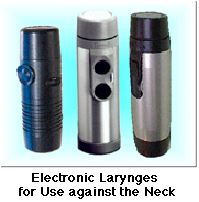
If purchasing one is not possible, contact your local support group or ACS (American Cancer Society) and see if they have "loaners" available. Some of our members feel that borrowing one before the surgery and practicing with it makes the transition easier.
ANSWERING MACHINE
If you have a land line, and you don't already have an answering machine or service, you will find that it is important to be able to receive messages, but using it to screen calls may be even more helpful. Even if you can speak some with the help of an electrolarynx, you may want to answer only when family and friends call but avoid having to go through an explanation to strangers or to fool with sales calls. The telephone company service, Caller ID, could help with knowing who is calling, but doesn't serve as many purposes for us as a simple answering machine.
GETTING ATTENTION
It is frustrating to need help with something that is not an emergency and not be able to raise your voice and call to someone, so most of us found different kinds of noise makers or ways to attract attention. A bell, bicycle horn, party noisemaker toy, inexpensive 2-way radio to signal, or anything you can find that will work for you. For loud outside noise makers, see Activities.
STOMA WHISTLE
 I bought a card of cheap whistles the other day at a party store, ($3.98 for 6), used some plastic cups, about two inches in diameter and one inch deep, that come as the containers in the drink mix, Crystal Lite, (no cost ... they are throw away items. A medicine cup might do depending on the size.) Cut a slot in the bottom to fit the mouthpiece of the whistle. Tape will seal the small openings around where the mouthpiece is inserted but a hot melt glue gun will drip a permanent seal around it. This should be washable.
You can now put cup to stoma and blow the whistle. You can put one in the car, one in your purse or pocket or hang it around your neck. Better whistles can be fixed when you need something very powerful (look under Activities) but the cheapies work for in the house or yard when you need to get someone's attention and they are not loud enough to scare the neighbors. Good as gifts to new larys.
(Pat Sanders)
HANDY WRITING TOOL
Although I use TEP now, when I first had my surgery I used EL and for several weeks was not very good at it because of the swelling. I carried a small magic writer in my pocket, a child's toy that I could write on, erase by lifting the transparent cover, and write on again. I used it for ordering in restaurants and whenever I needed to communicate and was having difficulty. I still pick one up at the local Toys 'R' Us or dime store whenever I visit a new patient. I found it to be essential in the hospital post op to communicate with family and friends as well as the hospital staff.
(Roger Jordan)
TALK ABOUTS
My husband and I have purchased "Talk Abouts". They are like a child's walkie-talkie only more advanced and have farther range. We not only use them in our home, but when we are out, if I need help and he isn't close to me, I can reach him at anytime. They are extremely clear. The price starts about $69.00 and goes up according to what range you want to have. They can be purchased at places like ABC warehouse, Montgomery Wards, Sears ... maybe Radio Shack ... these stores are pretty much nation wide.
SMOKE AND CARBON MONOXIDE DETECTORS
It is especially important that we check the batteries in our smoke detectors since our sense of smell has been compromised and we may miss the smell of smoke. If we live alone or even spend any significant amount of time by ourselves we need to take particular care that the detectors are operational. The batteries should be replaced at least twice a year, and checked more often. Checking them typically involves verifying that a light is on, or pressing a button which should cause the alarm to sound. One way to remember to change the batteries is to use the occasion of turning our clocks forward one hour in the Spring, and back again in the Fall, as a reminder. One of the side effects of the laryngectomy is partial loss of the sense of smell, making a smoke detector a must. Check the batteries on schedule.
HUMIDIFIER
Actually you may want to get more than one, particularly for use during the winter or when the relative humidity is very low. One caution is to be careful not to place a humidifier in close proximity to a computer.
Humidifiers need to be properly maintined and cleaned. The following is and artice that discusses these concerns.
http://time.com/4685972/humidifier-disinfectants-bacteria-water/
I had ultrasonic humidifiers from Costco...quiet, great until one day I noticed my gas burners were burning orange. I looked it up, google (what would we do without google?). Sure enough, it was the ultrasonic humidifiers. I didn’t have white dust but a film which wasn’t noticeable until then. I caused myself a lot of work everything had to be cleaned, anything glass had the film on it.
Rita NJ
HUMIDIFICATION AND IRRIGATION
(These are the instructions sent home with new laryngectomees from UAB Hospital)
Humidify
Use a cool mist humidifier by your bedside. Clean it regularly.
Wear a stoma cover to hold in the moisture being lost as you breathe.
A dampened stoma cover will add moisture to the air you breathe and can be kept damp with a small spray bottle of water.
Irrigation
Irrigation: squirting water or saline solution into the stoma.
Schedule: 4 times a day or as often as needed
Quantity: 2 or 3 ccs each irrigation, can be repeated several times
Applicator: any size needle-less syringe or pipette (pipet)
TEP prosthesis irrigation: pipettes are made in a size that fit directly into the base of the prosthesis. One inch or more of the tip of the pipette can be cut off and inserted into the end of a syringe. This provides the tip that fits into the prosthesis and a supply of water from the syringe can be used to flush through the prosthesis for cleaning in place.

In the event that this is what you are sent home from the hospital with and don’t have saline bullets. Please follow the guideline for saline products. "Guideline on Saline products: Once exposed to the air, the countdown to bacterial contamination begins even with opened sterile saline products. If stored at room temperature it is recommended to discard any remaining product after 3 days. If stored in a refrigerated state the shelf life may be extended a day or two."
YOUR OWN HUMIDIFIER
Personall humidfier machines are usually provided by insurance and delivered to you at the time you go home from the hospital.
A thorough cleaning by soaking the hose and attachments for 15 -20 minutes in a two to one ratio solution of vinegar and water every third day is recommended. The solution should be two cups vinegar to one cup water. Finnaly rinse throughly before use.
AIR PURIFIER
Some laryngectomees invest in the purchase of an air purification system, especially if they have pets. Depending on the size of your living space, you can use one large unit, or purchase several smaller ones for use in different rooms. You might just prefer one in the room where you spend the most time.
RESPIRATORY SPRAYS
Any lary needing a respiratory aerosol spray of any type should ask their Dr. about an aero-chamber. Drs. routinely receive them as samples and will likely provide one at no cost. An aero chamber is a plastic tube with a trach mask on one end and an opening on the other to receive the aerosol dispenser and disperses the medication more effectively. Mine was prescribed by a pulmonologist for emphysema.
(Stan Mruk)
STAY AWAY FROM AEROSOLS
Try to eliminate aerosol sprays from the house. Remember you are breathing directly into your lungs without the normal filtering system. If hair spray stiffens your hair, imagine what it does to your lungs! Try a stick, rather than a spray deodorant. Don't use aerosol air fresheners or aerosol cleaning products and avoid strong smelling products of any kind.
NOTIFYING OTHERS
NECK BREATHER MEDICAL BRACELET
A stainless steel bracelet is available that will let anyone know you are a Neck Breather. They can be purchased from Luminaud..

MEDIC-ALERT
Residents in Canada and the US have another alternative and that is to order a MedicAlert bracelet. MedicAlert provides a 24-hour toll-free emergency hotline which allows health care professionals and emergency workers instant access to your medical conditions, medication, allergies, special needs, personal requests, physician phone numbers and emergency contacts. Medical information can be updated and changed at any time free of charge.
NOTIFY YOUR "911" DISPATCHER OF YOUR "CONDITION"
It may well be a good idea to contact your local "911" dispatcher's office about your "condition", so that they are prepared to act if and when you call.
LET GRAVITY WORK FOR YOU
When the larynx is removed, so is the sphincter at the top of the esophagus so it is not a good idea to bend over after eating or drinking. This is particularly true in the early days following the operation. If you raise the head of your bed, you will let gravity work for you at night to keep the acids in your stomach where they belong.
MAKE SURE THEY KNOW AND UNDERSTAND
As an OR nurse and the wife of a lary, I find it very scary when David needs to have anything done. I am lucky if he comes to my hospital, in that I can speak to the staff looking after him and ensure they fully understand his different anatomy. Most are well informed these days as I've been talking about him for the last 2.5 years. Even so, I always make up a show bag ready for his procedure. It consists of a round baby resus mask, a flexible reinforced ET tube, a trach mask, a catheter (in case they pull his prosthesis out). Not everyone has the luxury of being able to do that though, but you can still request to have those items available should they be required.
I have laminated posters that I printed out that live in his grab bag. If he goes to the ER for any reason, I stick them on the wall. If he gets admitted to the ward, they get stuck on the wall there. They consist of the difference between a tracheostomy and laryngectomy, an anatomical picture showing the airway, a sign saying "my nose is just an ornament. Please apply oxygen to my stoma. That's the little hole in my neck", CPR for neck breathers, and a few others. Every single person that cares for him in the ED or the ward, I go through absolutely everything with them regarding his airway and then I get them to repeat it back to me. Last year he had to go for a CT scan. I went through the usual "in the event something happens, intubate via his neck. DO NOT put ANYTHING in his mouth or nose. Forget they are even there" with the radiographer. It felt quite disturbing at first, saying that kind of stuff, but it doesn't bother either of us now.
It's surprising the difference it makes having the posters up. People actually look at them. They really look at them and take notice. It often encourages them to ask questions. Even people who aren't looking after him come and ask questions, which is great! The more people that ask, the more people that know.
It still scares the carp out of me though because I can't be there 24/7 advocating for him. David has a very normal sounding voice, which could easily make people forget that he doesn't have a larynx.
For those facing a procedure, ask to speak to your anaesthetist before surgery day. You need to know they fully understand. Even if it's at the hospital you had your laryngectomy at, don't assume they know. Some questions you could ask:
Do you understand the difference between a total neck breather and someone who has a tracheostomy? Please explain the differences.
How would you administer oxygen to me?
If I need to be intubated, what type of tube will you use and where will you put it? (The type of tube should be a reinforced, flexible endotracheal
tube)
What would you use to bag and mask me? (Ideally a round size 1 neonatal resuscitation mask, or a paediatric mask turned sideways) You can even throw in a trick question......What will you do in the event I have a laryngeal spasm? If they go through the protocol for that, ask for a new anaesthetist because it is impossible for you to have a laryngeal spasm. It means they haven't listened to anything you've said or asked.
I have looked after a few of the local larys when they have come in for a procedure. I made a point of seeing them before, letting them know who I was and that I was married to a lary. You could see the look of relief on their face. I also reassured them that everything is set up for them and everyone in the room knows how their needs differ from everyone else. The ones with an EL were allowed to keep it on them. There was never any question of it being taken away.
I'm hoping that as of early next year, my local hospital will be the most knowledgeable when it comes to knowing about larys. David is starting work there in January and will be in a role where he will come in contact with pretty much every person in the building. Knowing how he can't shut up, absolutely everyone will hear from him!
TL:DR explain, explain, explain and explain to the staff, over and over and over. Get them to repeat everything back to you so you know they understand.
Jane (Wife of David - total laryngectomy, bilateral neck dissection 7/7/16,
Australia)
One of the mistake made often is that the healthcare professional confuse being a total laryngectomee, with having a trach. With a trach patients can often breath both through the mouth and the Trach. The other thing to consider is that they deal with normal patient day after day so it is automatic for them to think we breathe through our mouth. It is a very easy mistake to happen and it has happened to me. That is why it is so vitally important that we make sure they understand. I always request to meet with the anesthesiologist prior to any procedure even if they do not feel they will be putting me totally under. I also discuss with them that if I do not have my EL, I will not be able to respond to them. I even do this when I am going through security at the airport. They are always understanding and supportive to me, and thank me for bring it to their attention.
Ron Mattoon
Seattle, WA 2010
HINTS
POST-SURGERY DRAINS
Because of additional surgery, I am having to leave the drains in for a while. My daughter, Jane, made Kangaroo pouches , large sown on pockets on some t-shirts to hold the drain bulbs - pretty neat idea from an 11 yr old and really very comfortable when moving around.
(Bill Snowden)
TAKING A SHOWER
 In the laryngectomee supply catalogs, you will find several varieties of shower guards that fit around your neck and have a half cone shape over the stoma area. This protects the stoma area from the direct blast of the shower. A few drops of water splashed in the stoma will not hurt you, but you will be more comfortable with a shield. Later, you may not need it. With a well healed stoma, you can take a breath, put your finger or thumb over the stoma and step into the stream of the shower long enough to rinse your face.
HAND HELD SHOWER HEAD
One of the hand held replacements for your regular shower head will make it easier to direct the flow of the water around and away from the stoma.
ATTITUDE
Most of us find that the better the attitude, the faster the recovery. Apply yourself to learning the new ways of living and keep your spirits up.
For suggestions, contributions, corrections or questions about this section, please contact: